

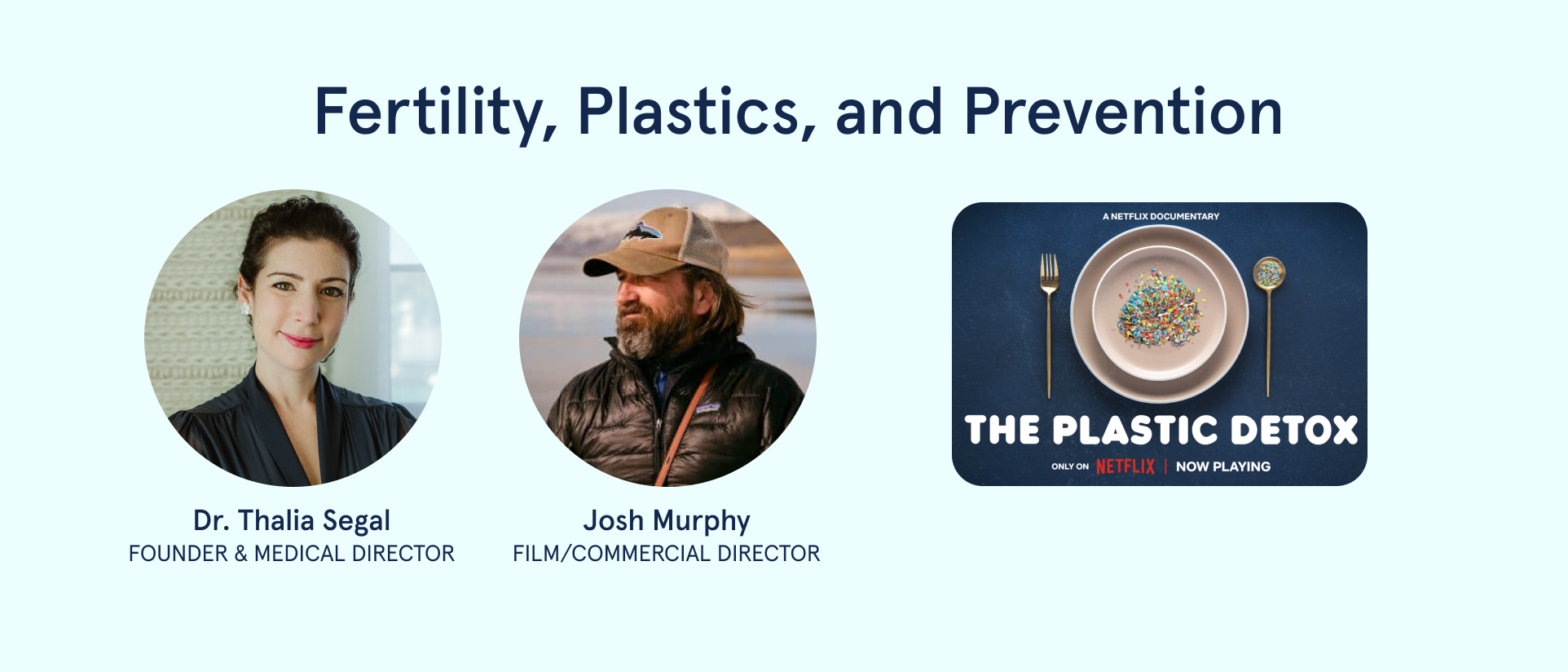
The Plastic Detox: a conversation with Dr. Thalia Segal and Josh Murphy
As conversations around fertility continue to evolve, so does our understanding of the many factors that work to influence reproductive health.
The Netflix documentary The Plastic Detox has helped bring the conversation about plastics, endocrine-disrupting chemicals (EDC’s), and other environmental toxic chemical exposures to light, highlighting how they affect human health and fertility.
The film features leading experts in environmental and reproductive health, including Shanna Swan, PhD, an environmental and reproductive epidemiologist known for her groundbreaking research on declining sperm counts and the growing male infertility crisis, and author of the highly esteemed book Countdown,
We sat down with Collab Fertility Founder and Medical Director, Dr. Thalia Segal and The Plastic Detox Co-Director, Josh Murphy, to discuss the making of the documentary, how environmental exposures show up in fertility care, and why this conversation feels more important than ever.
How the Plastic Detox sparked a larger fertility conversation
What inspired The Plastic Detox documentary?
Josh Murphy:
"Most films about plastics focus on plastics in the ocean, the environment, and wildlife. It’s all about the waste, piles of waste in India, rivers full of plastic, but it was all about the material and then the impact of that material on the environment and wildlife. Only a couple of films had kind of dealt with some of the health impacts, but not many.
I was a scientist before I was a filmmaker, and it always kind of troubled me, the impacts on the environment, but I had never really dived into the impacts of plastics on human health.
I went back and read all the primary reporting from the scientists doing the work, and then read more of the journalists' reporting on the scientists. And I thought, this is our film!
As we began to walk in the dark room of original storytelling, we began to say, okay, how do we tell this story, and what will the film reveal? We started telling a story, oddly enough, about whales because they are filter feeders and were filtering so much plastic that it was impacting fertility. That led us to the fertility theme.
Then we started looking at the impacts of plastics on autism, Lewy Body, and we began to kind of focus more and more and more on the human side."
As they continued researching, fertility and reproductive health kept emerging as a major theme.
That eventually led The Plastic Detox team to Dr. Thalia Segal, who could connect the science to real patient care.
How can environmental factors impact fertility?
Dr. Thalia Segal:
"The mission really aligned with what I was already preaching to my patients and other providers. Why are we seeing record levels of breast and colorectal cancer in people in their 30s? Why are IVF cycles going sky high? Why is all of this happening?
I really do believe it's the environmental contribution of plastics, pesticides, phthalates, etc., being everywhere.
It was nice to see a new format to broadcast this message to millions of people and make them more aware and then give them practical guidance on how to make changes, so it’s not all doom and gloom."
What did the documentary reveal about microplastics causing fertility?
Josh Murphy:
"When we began the intervention, I said to Dr. Shanna Swan, do you think we are going to see a change from the beginning to the end? And she said, ‘I know we will, but that change is going to be in body burden levels.’
She said, ‘Do not expect a pregnancy. Don’t! Just take it right off the table.’
What surprised me most was how much somebody could actually change their values in a three-month period.
When people see that in a 90-day period they can do something that has a real empirical change that can be measured, then they're going to be motivated."
How can environmental toxic chemicals impact fertility?
Dr. Thalia Segal:
"All my patients are just like the six couples in the movie. This is what I hear everyday: ‘We've been trying for two years. We did all the testing, and it's unexplained infertility’. They say, ‘What else can I be doing?’"
I love that question because there is a lot you can be doing at home that can reduce your exposure to these chemicals which can be having a real impact on your ability to conceive.
All Collab patients complete an environmental toxic chemical assessment questionnaire at their initial consultation. It’s five questions.
- How often do you drink from plastic bottles?
- Heat or store food in plastic?
- Do you buy organic produce?
- Do you use fragrance-free personal care products?
- Do you use Teflon non-stick pans?
Then we go through their answers, and I use that as a jump-off to provide practical guidance on how to detox their lifestyle.
For example, purging all your plastic, switching to glass and stainless steel, and never trusting BPA-free plastic. It’s just as bad, and that's news to people."
We discuss this in length in our blog on microplastics.
Where do most microplastics come from?
Dr. Thalia Segal:
"I think cosmetics and personal care products are huge. You think if it’s on the shelf, it’s safe. Most women use an average of 14 products a day.
Cooking is another one. I am surprised how few people realize what they're cooking with every day is toxic.
There’s also a lot of greenwashing. You go to the freezer section, and it says microwave safe on a plastic frozen dinner. There’s nothing safe about that."
Josh Murphy:
"People often think about plastic water bottles, but they don’t think about receipts, canned food linings, cookware, synthetic fabrics, or personal care products.
Plastic is the oil we touch every single day.
We interviewed a Harvard researcher who did a study using canned tomato soup versus homemade tomato soup. The canned tomato soup spiked BPA levels to a point where the CDC had never seen before because the acidity of the soup was pulling the bisphenol out of the lining of the can."
How can you reduce plastic use in daily life?
Dr. Thalia Segal:
"I always tell patients small changes make a big difference.
The half-life of BPA and phthalates is about six to twelve hours. You can really eliminate these things from your body.
It’s never going to be everything. Once in a while, I want my iced matcha latte, but at least I get iced, so it's not melting the plastic into my beverage. I would never get a hot drink in a to-go cup.
Patients walk away feeling empowered and excited to make changes in their lives."
Josh Murphy:
"You cannot remove plastic from your entire life entirely. It's just not possible. But there are really concrete ways of decreasing your exposure.
Do the things that you can control and just kind of look away from the others and find ways to work around them.
Consumer choice and behavioral choice do work."
Why is awareness around plastics and fertility growing?
Josh Murphy:
"There seems to be a moment happening where the film landed in a larger conversation and supercharged that conversation.
To achieve real change we need to focus on People, Policy, and Product. People have to want to change first, then either the product meets that new demand or the policy makes the product producers meet that new demand."
Dr. Thalia Segal:
"I’ve been studying endocrine disruptors since my fellowship in 2015, so I've been thinking about this a really long time. Nobody cared at that time.
Finally, I feel like there’s more awareness, so it’s a very exciting time for hopefully seeing real change in policy at a higher level."
What is the future of fertility, environmental health, and policy?
Josh Murphy:
"I’m really excited that we have a film to share that people can talk about.
The film is not meant to create fear. It’s meant to help people recognize there are practical ways to reduce exposure and make healthier choices.
As a filmmaker making impact films, I’m not selling popcorn. I’m selling the fact that after you see this story, you need to do something different."
Dr. Thalia Segal:
"This is a very exciting time to have this conversation. People are asking better questions. There’s more awareness.
Fertility is not only biological. It’s also environmental.”
Why Dr. Segal joined the project
For Dr. Segal, participating in the documentary felt like a natural extension of the work she was already doing.
"The mission aligned with what I was already talking to patients about," she said. "Why are we seeing rising infertility rates? Why are IVF cycles increasing? Why are we seeing record levels of certain cancers in younger people? I do believe environmental exposures are part of that conversation."
At Collab Fertility, environmental health is already integrated into patient care through what we call The Collab Way.
"I wanted people to understand that this isn’t just doom and gloom," Dr. Segal explained. "There are practical changes patients can make that may meaningfully reduce exposure over time."
The surprising outcomes of the film’s fertility intervention
One of the most compelling storylines in The Plastic Detox follows couples participating in an environmental intervention aimed at reducing exposure to plastics and endocrine-disrupting chemicals.
Murphy admitted that even the filmmakers did not expect the level of measurable change they ultimately documented.
"The original expectation was that we would see changes in body burden levels, meaning reductions in measurable chemicals," he said. "We were told not to expect pregnancies."
Instead, the intervention revealed something more powerful: that relatively small lifestyle changes could lead to significant measurable differences in exposure.
"What surprised me most was how quickly people could reduce these levels," Murphy said. "That gave people something they often don’t feel in conversations around environmental health, which is agency."
For Dr. Segal, the film reflected what she sees regularly in fertility care.
"Patients are constantly asking, ‘What else can I do?’" she said. "Many patients have unexplained infertility, and they want guidance beyond standard testing."
Hidden sources of plastic exposure
One of the major themes explored in The Plastic Detox is how many environmental exposures are effectively invisible.
"People often think about plastic water bottles," Murphy said. "But they don’t think about receipts, canned food linings, cookware, synthetic fabrics, or personal care products."
Dr. Segal agreed that many patients are surprised to learn how widespread exposure can be.
"People assume if something is sold on a shelf, it must be safe," she said. "But there’s a lot of greenwashing in this space. Labels like ‘microwave safe’ or even ‘BPA-free’ don’t necessarily mean risk-free."
Murphy described one study discussed during filming in which students consuming canned tomato soup experienced dramatic increases in BPA exposure because acidic foods interacted with the lining of the can.
"You realize these exposures are happening in ways most people never think about," he said.
Why the conversation around fertility is changing
Both Murphy and Dr. Segal believe awareness around plastics and fertility is reaching an important turning point.
That growing awareness is beginning to influence larger conversations around public health and policy.
Dr. Segal recently joined the legislative board of ACOG and shared that California’s AB 1604 legislation to remove bisphenols from receipts was recently endorsed.
Dr. Segal recently joined the legislative board of ACOG and shared that
Murphy added that the documentary’s release appears to be accelerating public conversations about environmental health.
"People, policy, and product," Murphy said. "That’s how change happens. People become aware first. Then policy and products follow."
Hope, not fear
Despite the serious subject matter, both Murphy and Dr. Segal emphasized that the film is ultimately intended to leave people feeling hopeful.
"One of the things people tell me after watching the film is that they didn’t expect it to feel hopeful," Murphy said.
That hope comes from understanding that many exposures are modifiable.
Importantly, Dr. Segal also cautions patients not to delay fertility evaluation or treatment while making lifestyle changes.
"Environmental changes should happen in parallel with fertility care, not instead of it," she said. "Age and underlying medical conditions still matter significantly."
For both Murphy and Dr. Segal, the goal is not fear, but empowerment.
"Once people understand where exposures come from," Dr. Segal said, "they feel more informed and more in control of their health decisions."
The Collab Way: Integrating environmental health into fertility care
At Collab Fertility, environmental health is part of a broader, whole-person approach to reproductive care.
Through The Collab Way, our team helps patients understand how lifestyle, nutrition, environmental exposures, and overall wellness may intersect with fertility.
As research continues to evolve, conversations like these are helping patients better understand the many factors that contribute to reproductive health — and the meaningful changes that may support it.
If you’re interested in learning more about environmental health and fertility, or exploring a more comprehensive approach to reproductive care, our team is here to help.
Schedule a consultation to learn more about The Collab Way.
________________________
Proudly Supporting Local Communities
Collab Fertility is honored to serve families in the East Bay like Danville, Alamo, Orinda, Lafayette, Moraga, Piedmont, and Walnut Creek, as well as many other communities in the Bay Area and beyond, including Oakland, San Ramon, Concord, Pleasant Hill, Santa Rosa, Novato, Napa, Sonoma, and more.
Latest Articles

Endometriosis and fertility: a Q&A with Dr. Deepti Nahar and Dr. Thalia Segal
