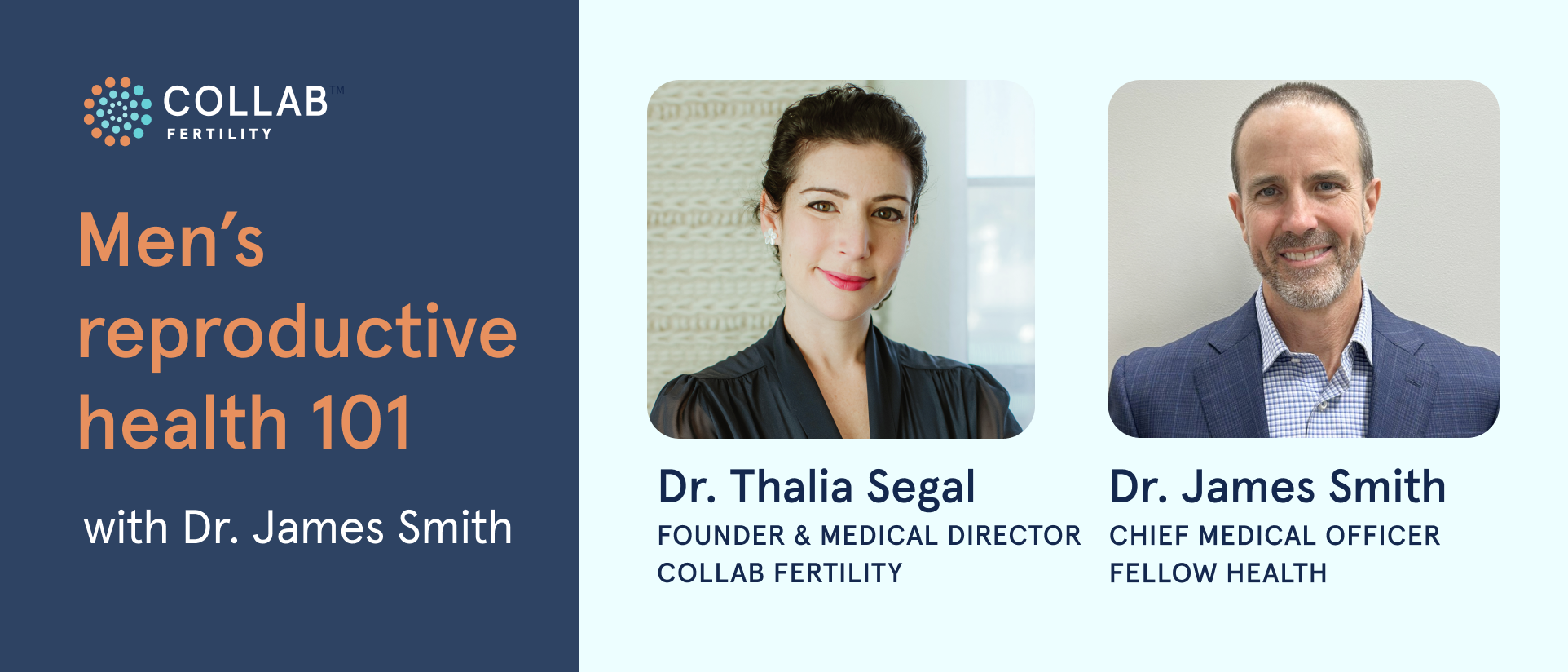
Men’s reproductive health 101: Dr. James Smith answers common questions about male fertility
Men are often left out of the fertility conversation, even though male factors contribute to infertility in nearly half of all couples. To help close that gap, Collab's founder and Medical Director, Dr. Thalia Segal, invited Dr. James Smith — a reproductive urologist and nationally recognized expert in male fertility — to serve as an expert advisor.
Dr. Segal recently sat down with Dr. Smith to discuss the questions men (and their partners) most commonly ask about sperm health, fertility, and reproductive aging. In this Q&A, he breaks down what men should know about fertility, sperm health, age, and when to get tested — in clear, practical terms.
What are the signs of infertility in men?
Dr. Smith:
Infertility is typically defined as six to twelve months of unprotected intercourse without pregnancy. In most couples, about half of the time, there is a male factor involved, whether that’s the whole problem or at least part of the problem.
Figuring out whether a man has fertility issues really starts with a semen analysis. You have to look at whether a man has sperm at all, whether the sperm are swimming well, how many sperm there are, and what the sperm concentration looks like. That’s really the starting point for understanding male fertility.
Can low testosterone cause infertility?
Dr. Smith:
It can, but it’s not a one-to-one relationship. I often explain to patients that the testicles have two jobs: they make sperm, and they make testosterone, and those processes go together.
If there isn’t enough testosterone inside the testicle, men don’t make sperm very well. One thing men often don’t realize is that taking testosterone can actually hurt fertility. You can raise testosterone levels in the blood, but that tells the brain everything is fine, and the testicle stops making its own testosterone. That suppression inside the testicle can reduce sperm production.
Does sperm count decrease with age?
Dr. Smith:
Yes, but much more gradually than it does for women. It does look like sperm count can decrease for some men as they get older. This decline tends to be more of a decade-by-decade decline rather than a sudden drop.
Men generally make sperm their whole lives, but we do think sperm quality probably decreases a little bit as decades go by.”
What is the peak age for male fertility?
Dr. Smith:
That’s a really good question, and I don’t have a perfect answer. We don’t usually think about male fertility in terms of a specific peak age the way we do for women.
Instead, we look at semen analysis results. Whether a man is 22 or 42, if he has a good number of moving sperm, we’d say he has a good chance of conceiving. It’s much more about the quality and quantity of sperm than about age alone.
Does age matter for guys when it comes to being fertile?
Dr. Smith:
Age by itself usually isn’t the strongest factor for men. What’s more important is overall health.
When we look at tens of thousands of semen samples, about a third of men have abnormalities that are significant enough that I’d want to see them in my clinic; another 20-30% have at least one abnormality that would meet the World Health Organization criteria for being abnormal. Many of those issues are potentially modifiable — things like being overweight, being diabetic, taking testosterone, certain medications, heavy alcohol use, or heat exposure like hot tubs or saunas.
If men get checked earlier, even before they’re actively trying to conceive, they have the opportunity to make changes that can really improve their fertility.
What are common reasons for infertility in men?
Dr. Smith:
Health and fertility often go together. The same things that are good for your heart are also good for your sperm.
That includes eating lots of fruits and vegetables, especially antioxidant-rich foods like leafy greens, getting regular exercise, managing stress, and limiting alcohol. Environmental factors matter too — things like smoking, marijuana use, some medications, or heat exposure.
As a bonus, all of those things are also good for erections.
Can an older man’s sperm cause birth defects?
Dr. Smith:
To make a baby, you need sperm and eggs, and each contributes about half of the genetic material. Birth defects can come from either side.
As men get older, sperm quality probably declines, and we see higher levels of DNA fragmentation over time. Older fathers, typically defined as over 40, do have slightly higher rates of children with certain mental health conditions like autism or bipolar disorder.
That said, this is a relative increase in risk. The absolute risk is still small, but it is something we can detect statistically.
How do you preserve sperm?
Dr. Smith:
For men facing fertility-threatening events, sperm banking is the right thing to do. That means producing a semen sample and freezing it in liquid nitrogen.
Those samples can be frozen indefinitely — ten years, twenty years, even longer. Current guidelines (ASCO 2025) strongly recommend banking sperm for anyone facing cancer-related fertility risks.
Age alone, however, is not usually a reason to freeze sperm. For example, I wouldn’t recommend a 25-year-old freeze sperm just because he’s not sure when he wants kids. His sperm at 35 will likely still be fine.”
What are fertility preservation options for cancer patients?
Dr. Smith:
For male cancer patients, sperm banking before treatment is the primary fertility preservation option. Chemotherapy, radiation, and some surgeries can affect sperm production, so preserving sperm beforehand gives patients more options later.
The key is doing it before treatment begins.
What is sperm morphology?
Dr. Smith:
Sperm morphology is one part of a semen analysis. We look at semen volume, sperm concentration, motility — how many sperm are moving — and morphology, which refers to sperm shape.
Morphology causes a lot of concern, but it’s not as important as the big 3. With today’s very strict criteria, a lot of sperm that are capable of making healthy babies get labeled as abnormal.
As long as a man has a good number of moving sperm, abnormal morphology alone (most of the time) doesn’t mean very much.
How do you improve sperm morphology?
Dr. Smith:
I don’t look at morphology by itself. I look at the entire semen analysis to understand what might be affecting sperm health.
If motility is low, I’m asking about smoking, diet, or marijuana use. If sperm count is low, I’m thinking about medications or genetic conditions. Morphology is just one piece of the puzzle. It helps guide questions, but it’s not usually the main driver of fertility outcomes.”
What is your most important advice for men?
Dr. Smith:
The most important message for me is that men should get tested earlier. Don’t wait until you’ve been trying for a year and are already frustrated. Getting this information early gives men the chance to make changes, advocate for their health, and be active participants in the fertility journey, not just bystanders.
Taking the next step in men’s reproductive health
Male fertility is often overlooked, but as Dr. Smith emphasizes, understanding men’s reproductive health early can make a meaningful difference in the fertility journey. If you’re thinking about starting a family, experiencing challenges conceiving, or simply want a clearer picture of your reproductive health, getting evaluated sooner rather than later can help you feel informed and empowered.
At Collab Fertility, we take a whole-person approach to fertility care through our integrative care model, The Collab Way. We agree with Dr. Smith that men can be empowered to be active participants in the process. To learn more about male fertility and testing, reach out to us today.
About Dr. James Smith
Dr. Smith is Chief Medical Officer at Fellow Health, the largest male reproductive health company in the United States, providing high-quality and accessible semen analysis testing.
With over 20 years of experience in urology and reproductive health, Dr. Smith is also Clinical Professor of Urology at UCSF, where he cares for patients with various medical and surgical reproductive health conditions and mentors medical students, residents, and fellows.
Dr. Smith has led and collaborated on multiple high-impact research studies, ranging from basic investigations of sperm physiology, translational applications of fertility preservation for cancer patients, epidemiological studies designed to improve access to male reproductive health care, to multi-institutional nationwide cancer biomarker clinical trials.
Dr. Smith has served as president of the Society for the Study of Male Reproduction (SSMR), president of the Society for Male Reproduction and Urology (SMRU), Chair of the Fertility Preservation Special Interest Group (FPSIG) within the American Society for Reproductive Medicine (ASRM), and is currently Vice President of the American Society of Andrology.
________________________
Proudly Supporting Local Communities
Collab Fertility is honored to serve families in the East Bay like Danville, Alamo, Orinda, Lafayette, Moraga, Piedmont, and Walnut Creek, as well as many other communities in the Bay Area and beyond, including Oakland, San Ramon, Concord, Pleasant Hill, Santa Rosa, Novato, Napa, Sonoma, and more.
Latest Articles

Can fibroids affect fertility and pregnancy? A Q&A with Dr. Deepti Nahar and Dr. Thalia Segal