What are IVF success rates, and what patients should know
Updated September 2026: This article has been updated to reflect Collab Fertility’s latest IVF outcomes and the most recently available national data. Our latest results continue to show ongoing pregnancy rates above the national average across every age group reported below.
By providing integrative care and cutting-edge treatment, Collab Fertility exceeds national averages
When patients begin exploring IVF, one of the first and most confusing questions they encounter is: What do IVF success rates actually mean for me? IVF success rates are one of the most searched topics in fertility care, and for good reason. Patients want clear, trustworthy information about their chances of success before starting treatment. However, these rates can be difficult to interpret without understanding what those numbers actually measure and how they apply to individual patients.
In this article, we explain IVF success rates, how IVF statistics are calculated, how Collab Fertility’s outcomes compare to national figures (hint: we are well above national averages across age groups!), and why personalized fertility care matters more than any single statistic.
What IVF statistics measure, and who they apply to
IVF statistics typically report outcomes such as pregnancy, ongoing pregnancy, and live birth rates. They are often grouped by age and may be reported per cycle, per embryo transfer, or per patient.
When reviewing IVF statistics, it’s important to ask:
– Are these IVF success rates reported per cycle, per transfer, or per patient?
– Do they measure ongoing pregnancies, live births, or both?
– Do they apply to patients using their own eggs?
– How is age factored into the data?
How Collab’s outcomes compare to national IVF success rates
When IVF outcomes are compared by age group, Collab Fertility’s latest results exceed the national average across every age group shown.
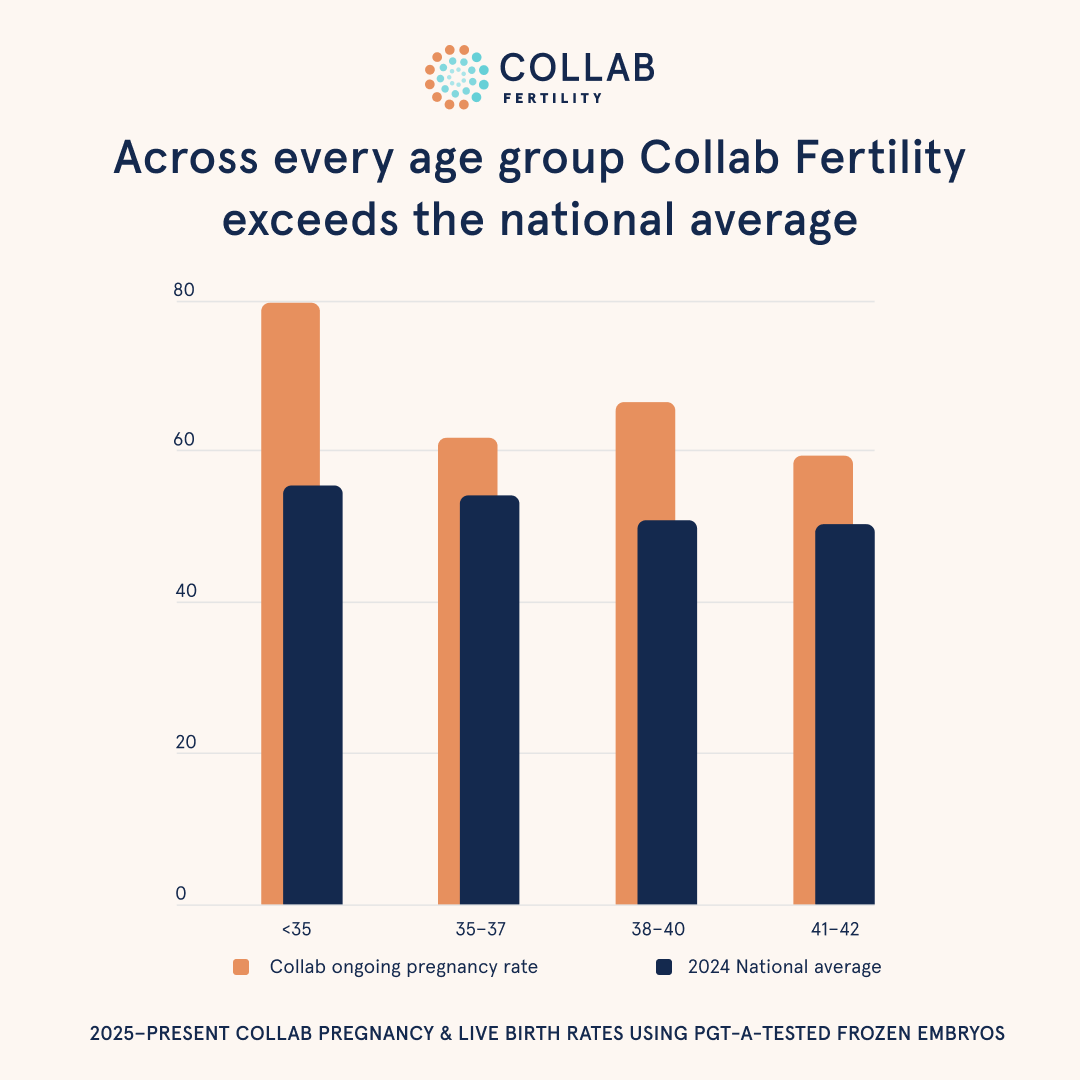
Collab’s ongoing pregnancy rates are compared here with 2024 national averages. While success rates can provide a helpful benchmark when choosing a fertility clinic, every patient’s likelihood of success is individual and can be influenced by age, diagnosis, ovarian reserve, treatment history and other factors.
Source: SART National Summary Report for 2024
Why national IVF data (SART) is always slightly delayed
The national comparison shown above uses 2024 data because fertility success rates are not reported in real time. The Society for Assisted Reproductive Technology (SART), which publishes U.S. IVF outcomes, collects and verifies data from clinics across the country before releasing its annual reports.
Because of this process, SART data typically reflects outcomes from approximately two years prior. Clinics must complete treatment cycles, confirm outcomes such as live birth, and submit their data for validation before it is included in the final report. This ensures accuracy and consistency, but it also means the published data does not reflect real-time outcomes.
Why Collab Fertility’s IVF outcomes stand out
IVF success is shaped by how seamlessly every part of care works together—from the first consultation to embryo transfer. At Collab Fertility, strong outcomes result from an intentionally designed, highly coordinated model of care.
A cohesive, patient-centered team
At Collab, physicians, nurses, embryologists, and support staff work as a unified team with clear communication and an investment in each person’s success. Experienced physicians and fertility nurses closely monitor patients throughout treatment. Attention to timing, coordination, and individual response—especially across the menstrual cycle—is critical to optimizing egg development and overall outcomes.
Personalized protocols at every stage
IVF is not one-size-fits-all. Collab tailors treatment plans at every phase, including initial testing, pre-cycle preparation, in-cycle monitoring, egg retrieval, and frozen embryo transfer. Factors such as age, ovarian reserve, hormone response, and prior treatment history inform individualized protocols.
Meticulous monitoring and experienced nursing care
During each cycle, Collab's providers closely follow patients, tracking hormone levels and follicle development with meticulous attention to detail. At each monitoring visit, physicians and the nursing team review ultrasound imaging and lab results together, ensuring that dosing adjustments and next steps are thoughtfully tailored to each patient. This collaborative, real-time approach allows care plans to be adjusted precisely and helps optimize each cycle as it progresses.
A state-of-the-art lab
Collab’s IVF lab is led by an on-site laboratory director and equipped with advanced technology, including a LifeAire air purification system and modern incubators with individual chambers. Strict quality control and evidence-based practices for fertilization, biopsy, freezing, and embryo culture support consistent, high-quality outcomes.
Precision at critical moments
Egg retrievals and embryo transfers require technical expertise and close collaboration between clinical and lab teams. At Collab, these steps are approached with precision and intention, ensuring alignment across teams and optimal conditions for embryo development and implantation.
IVF outcomes matter, but understanding how those outcomes are achieved provides the clearest picture of what patients can expect.
What questions should you ask during an IVF consultation?
Here are some questions you should be asking a prospective fertility clinic:
– How will my fertility treatment be personalized?
– How does your clinic communicate with patients?
– Are your providers accessible after hours?
– How does my age and diagnosis influence my treatment plan?
– What laboratory technologies are used to support embryo development?
– Do you have an on-site lab? When was it built?
– Do you have a lab director on-site?
– How do nutrition, lifestyle, and environmental health factor into care?
– How do you define success and support patients throughout treatment?
What is the recommended number of embryos to transfer during an embryo transfer?
Another common question patients ask is how many embryos are transferred during IVF and how this affects IVF outcomes. Advances in embryo culture, genetic testing, and laboratory techniques now allow many patients to achieve strong pregnancy and live-birth outcomes with a single embryo.
In accordance with ASRM guidelines, Collab Fertility recommends single embryo transfer, particularly when preimplantation genetic testing (PGT-A) has been performed. With high success rates using one embryo, single embryo transfer minimizes the risk of twins and other multiple pregnancies while supporting the safest possible outcomes.
Why personalized fertility care matters more than any single number
IVF success rates are influenced by many factors, including medical expertise, laboratory quality, protocol design, and the patient's age and overall health.
At Collab Fertility, personalized fertility care is central to The Collab Way—an integrative approach that combines advanced reproductive medicine with in-house, personalized nutrition support, clean-living guidance, and whole-person care, including referrals to acupuncturists and therapists. Every Collab patient is enrolled in The Collab Way at no extra cost from the day they start treatment with us.
By tailoring treatment plans to each individual and couple, Collab optimizes outcomes while supporting patients at every stage of their journey. IVF success rates matter, but understanding how those outcomes are achieved matters even more.
Schedule a consultation to learn how our personalized, integrative treatment plans may support your path to parenthood.
FAQs
What is the difference between freezing eggs and freezing embryos?
- Egg freezing involves retrieving your eggs, freezing them unfertilized, and storing them for potential use later.
- Embryo freezing involves fertilizing your eggs with sperm to create embryos, which are then frozen for future use.
Who should consider egg freezing?
- Individuals who want to delay pregnancy for personal, career, or medical reasons.
- Individuals facing medical treatments (like chemotherapy) that may affect fertility.
- Those without a current partner who want to preserve reproductive options.
How long can eggs or embryos be stored?
Eggs and embryos can be stored indefinitely. Births have been reported when eggs have been frozen after 10–15 years.
What’s the advantage of embryo freezing?
Freezing embryos can make IVF outcomes more predictable, and improve the chances of a live birth for a few key reasons:
- Better timing for implantation
- Selecting the most viable embryos
- Allows embryos to be tested for genetic abnormalities
Delaying transfer avoids risks tied to high hormone levels, such as ovarian hyperstimulation syndrome (OHSS)
How can I find out which clinic has the best success rates?
When comparing fertility clinics, it’s important to look at more than marketing claims. Patients should review a clinic’s published success rates, including live birth rates, IVF outcomes by age group, and whether the data is reported through organizations like Society for Assisted Reproductive Technology (SART). It’s also important to consider factors beyond statistics alone, such as physician experience, lab quality, personalized treatment plans, patient support, and how complex cases are handled.
At Collab Fertility, our IVF lab uses advanced technology and 24/7 monitoring, and our embryology team carefully manages every egg and embryo with precision and care. We believe strong outcomes come from combining clinical expertise, leading laboratory standards, and personalized patient care.
________________________
Proudly Supporting Local Communities
Collab Fertility is honored to serve families in the East Bay like Danville, Alamo, Orinda, Lafayette, Moraga, Piedmont, and Walnut Creek, as well as many other communities in the Bay Area and beyond, including Oakland, San Ramon, Concord, Pleasant Hill, Santa Rosa, Novato, Napa, Sonoma, and more.
Latest Articles

Can fibroids affect fertility and pregnancy? A Q&A with Dr. Deepti Nahar and Dr. Thalia Segal